Labels

A'a (3) Aberystwyth (2) aerial ropeway (1) Afon Llia (1) Agua Amarga (1) alcazaba (1) Alcmonavis (2) Alcogida (1) Alicante-Cadiz fault zone (1) alkali basalt Tallante lherzolite hornblende xenolith (1) almagre (1) Almagro (1) Alpine orogeny (1) Alpujarride (1) Alte Schule Biergarten (1) Altmuhltal (1) ammonite (1) Andalucia (2) antequera (1) aquaduct (1) Aranjuez (1) Archaeopteryx (1) Ardales (1) Arundel (1) Aumuhle (1) Ballaison (1) Bandas del Sur (1) banos de montemayor (1) Barbary Ground Squirrel (1) barrier island. OUGS (1) basin (1) basin range gypsum karst dacite amhibole ibex (1) Bath (1) Bavaria (1) Bayuyo (1) beaconites (1) Bentham (1) Berger Museum (1) betics (1) Bideford (1) big rivers (1) Bilbao (1) Bovey (1) breccia (2) bridge (1) Brownstones (1) building stones (2) bunte breccia (1) Burgermeister Muller Museum (1) cable car (1) Cabo de Gata (2) Caen stone (1) Calatrava (1) calcarenite (1) calcrete (3) Caliche (1) caliphate (1) Caminito del Rey (1) Canterbury (1) carbonate sand (1) carbonatite (1) Carboniferous (5) Cardiff (1) casa de las columnas (1) Casa de los Coroneles (1) Castillo Santa Catalina (1) castle (1) cathedral (2) cathedral. (1) cave (1) cavern (1) cenozoic (1) central volcanic province (1) Chablais (1) chalcolith (1) channel (1) Chedworth (1) chromite (1) church (1) Clypeus Grit (1) coal (1) coesite (1) columnar joint (1) Conduit House (1) conglomerate (1) contact (1) contact aureole (1) copper age (1) Cornford (1) Craig y Fro (1) Cretaceous (3) cross cutting (1) cuchillete (1) cuchillo (1) cuenca (1) Cueva de los Llanos (1) CVP (1) dacite (1) Daimiel (1) Daroca (1) Dazu (1) despenaperros (1) Devils Elbow (1) Devon (1) Devonian (1) Dingle (1) dinosaur (1) Dinosaur Park (1) diopside (1) dolmen (1) dolomite (1) dome (2) dorsal ridge (1) dragon (1) dune (1) dunes (2) dyke (2) dykes (4) Eaux Chaudes (1) Eco-Museum (1) Eduard Opitsch (1) Egyptian Vulture (1) ejecta (1) El Cotillo (1) embalse (1) Eocene (1) epidote (1) erratic (1) fan (1) Faro (1) fault (1) fiesta (1) Fishbourne Roman Palace (1) flank collapse (1) flatiron (1) Flint (1) floods (1) fluvial (1) fold (2) folding. (1) fossil (1) Fossilien Besuchersteinbruch Muehlheim (1) Fossilien und Steindruck museum (1) France (1) Fuente De (1) Fuerteventura (11) Fuerteventuran Chat (1) gabbro (1) garnet (1) Gaspe (1) geology (16) geology Carboniferous limestone joints calcite Mumbles Limeslade (1) geology rodolith Messinian Almeria (1) Geopark (2) giralda (1) gneiss (2) goats (1) gorge (1) Gower (1) granada (1) Granada Basin (1) granary (1) granite (4) granite enclave (1) granodiorite (1) graphitic mica schist (1) Great oolite. OUGS (1) greater spotted cuckoo (1) Gryphite (1) Guimar (1) Gully Oolite (1) Guzenhausen (1) Haardt Quarry (1) Haitzalde (1) Harthof (1) Hemerdon (1) High Tor Limestone (1) Hisn-ashar (1) hispania glass (1) hornito (1) hoya de la mora (1) huetor tajar (1) hyaloclastite breccias (1) hydrothermal (1) ichnofossil (1) igneous (1) ignimbrite (2) impact (1) industrial archaeology broomrape scoria schist Mazarron (1) Inferior oolite (1) internal zone (2) Interpretation Centre (1) Ireland (2) Isla de Lobos (1) Iznajar (2) Jack Matthews (1) Jaen (1) James Jackson (1) Jandia (1) Jane Francis (1) Jardin del Principe (1) Judges Lodging (1) Jurassic (4) karst (2) Katherine Cashman (1) landslip valley (2) lapis specularis (1) Laruns (2) lava tube (2) Lavernock (1) Lawrenny Cliff Fm (1) Leon (1) lime kiln (1) limestone (14) lizard (1) Loja (1) Loja karst flowstone calcite crevillente fault (1) Lower Limestone Shale (1) Lundy lundyite geology OUGS (3) mafic dyke (1) magnafacies (1) Magnesian (1) Malaga (2) malpais (2) Malvern (1) mantle (2) map (1) marais (1) marine abrasion platform (1) Mark Williams (1) marl (3) Marquise (1) Mary Rose (1) Mary Tourtel (1) marzipan (1) Mercia Mudstone (1) Mesa Roldan (1) Mesozoic (1) metabreccia (1) metagranite (1) microgranite (1) migmatite (2) mine (1) mineral railway (1) mineralogy (1) Miocene (1) Molina de Aragon (1) Montejaque (1) mud cracks (1) mudrock (2) Munich (1) museum (1) Mutriku (1) Nasrid (1) National Museum of Wales (1) neolithic (1) Nevada (1) New Shipping Fm (1) Nordlingen (1) Notgrove (1) NW ridge (1) ocean crust (1) Ogmore (1) oil reservoirs (1) Old Red Sandstone (4) olistostrome (1) Oliver Rauhut (1) olivine (1) oolite (2) orchid (1) ordnance factory (1) organ (1) Otting (1) OUGS (23) Oxford Colloquium (1) Oxford Geology Group (1) Oxwich Head (1) pahoehoe (1) Palacio Real (1) Palaeocene (1) Palaeontology (1) palaeosol (2) palagonite (1) panopticon (1) Parador (1) Pembrokeshire (1) Penderyn. (1) penitentes (1) Pennant (1) peperite (1) peridotite (4) pierre a martin (1) pillow lava (3) pineau (1) Poblado de la Atalayita (1) porca (1) Portalet (1) Portishead (1) Portland (1) Portsmouth (1) Portsmouth Historic Dockyard (1) Precambrian (1) president (1) Presteigne (1) Puerto de Pajares (1) Purbeck Marble (1) pyramid (1) pyroxenite (1) Quarr (1) Radyr (1) Ragstone (1) rain drops (1) rainbow (1) raised beach (2) rambla (1) rapakivi (1) reefs (1) retrograde (1) rhodoliths (1) Rhone glacier (1) Richard Fortey (1) Ries (1) rif (1) rift arm (1) ring complex (2) rio genil (1) rock tomb (1) rodoliths (1) ROF (1) rojas rojos y violetas (1) roman (1) Roman brick (1) romanesque (1) Ronda (4) Roques de Garcia (1) Ros Rickaby (1) Ross on Wye (1) Rotherwas (1) Rovoree (1) Saintes (1) Salamanca (2) Salinas de Carmen (1) salt (1) San Pedro del Mar (1) sandstone (5) Santa Elena (1) Santander (1) Santillana del Mar (1) Santonian (1) scarp (1) scoria cone (3) Scrivener (1) sea-level (1) seamount (1) seamount series (1) sediment (2) segobriga (1) Senni Fm (1) Serrania (1) Severnside (5) Shamhaupten (1) shell filling (1) shield volcano (1) Shipway Limestone (1) Shoemaker (1) Shoestring Volcanoes Tenerife Lanzarote Fuerteventura Almeria Guadarrama Norway Sweden Newfoundland Gaspe Alps Pyrenees (1) Sierra Elvira (1) sierra nevada (1) Sierra Subbetica (1) Sierras Subbeticas (1) sika deer (1) Silurian (1) smoky quartz (1) snow (1) soplao (1) Southsea (1) spa (1) Spain (5) St Augustine's (1) St Georgskirche (1) St Martins (1) St Mary's Well Bay (1) staddle stone (1) stalactite (1) stalagmite (1) Stapleton castle (1) Storey Arms (1) storm (1) strombus (1) subaerial (1) subbetic (1) suevite (1) Sully Island (1) sunrise (1) syenite (2) syncline (1) Tears Point Limestone (1) Teide (1) Teno massif (1) Thanet Sandstone (1) Threlkeld (1) Toledo (2) Torrecaballeros (1) torrejoncillo (1) Torrox (1) Townsend Tuff Bed (1) transgression (1) travertine (1) tres reyes (1) Triassic (2) Trigonia Grit (1) Tufa (1) Tuff ring (1) ultra-K volcanic (1) unconformity (7) Vega ring complex (1) vesicles (1) Vidiago (1) virgen de las nieves (1) Virgen del Mar (1) visigoth (2) volcanic (1) volcano (2) Wales (4) walk (1) Warren House (1) wetland (1) wolfram (1) WWT (1) xenolith (1) zamora (1)

Sunday, 16 July 2017

Two old bats spend a day in the Pyrenees

Laruns and the Ossau Valley

Laruns square, with bakery.
I do like doorways.... and doors.... specially with wine behind them!
After a look around the town, and a sustaining coffee (and bun) in Laruns (the boulangerie to the left of the red and yellow awning) we drove on up towards the Col de Portalet. The drive up there was beautiful, stretches of gorge, and areas where the valley opened out more, and we stopped at a dam to find out about it.
A narrow bit

A wider bit at Les Eaux Chaudes

Mainly took this because of the rock layers. Well well well, rock comes in layers... OK but they showed up nicely!

The Fabreges dam - surprising to come across this after miles of gorge and valley
I'd not realised that the river was dammed to create the lake at Artouste

Barrage de Fabreges - which holds back a lake by the village of Artouste - there's a train from the village which does a four hour journey up into the mountains but we didn't feel we had quite enough time!
The "Petit train d'Artouste" is the highest narrow gauge railway in Europe and looks to be a spectacular ride.
A quick look around the grass below the dam showed some pretty flower - I especially liked the scabious. Seems to be a "blue flower" time of year!


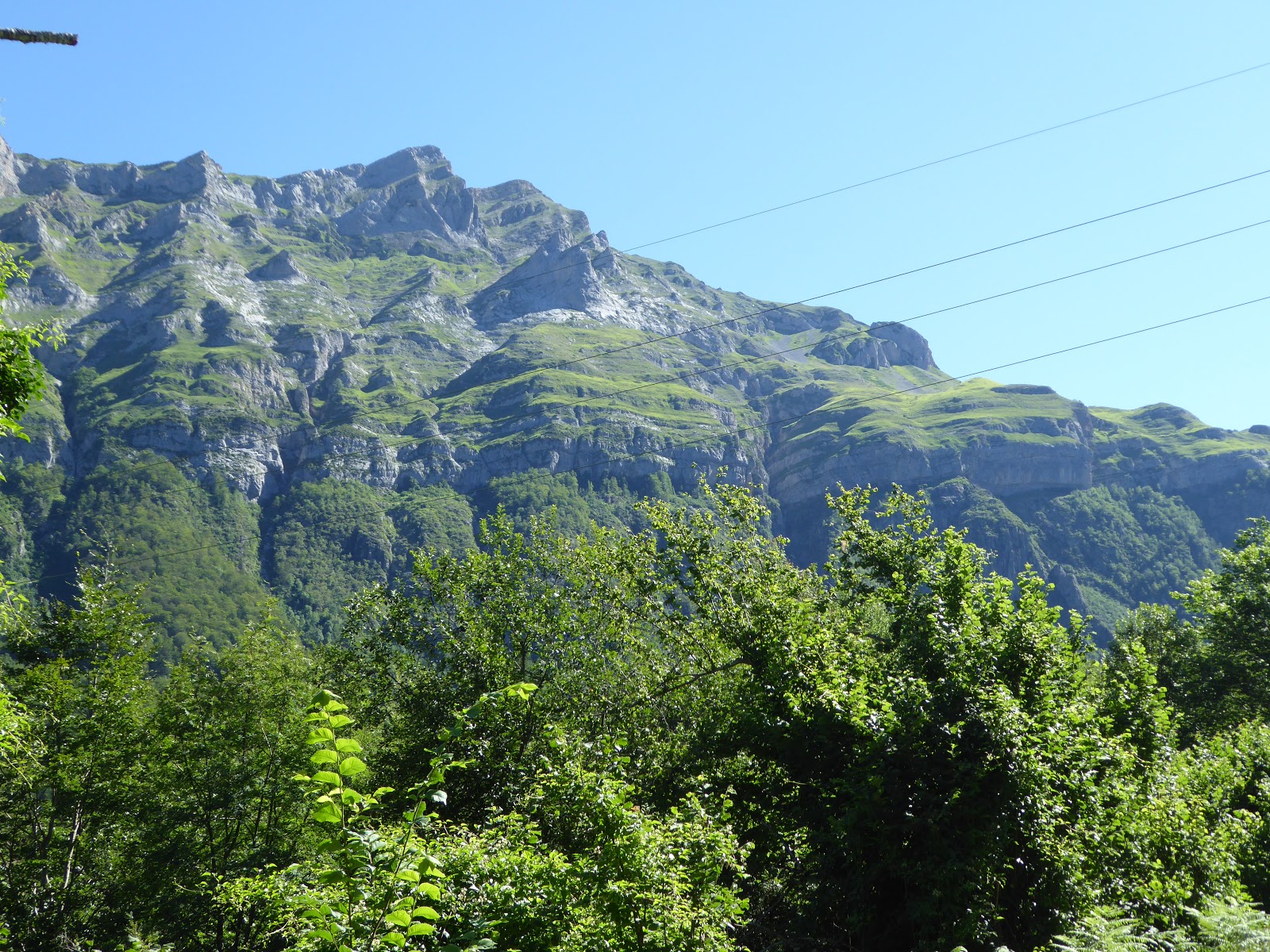
Upper Ossau valley and Col de Portalet

Onward and upward - and I can never resist a picture of some "curly rocks" - I think I first heard them called this in the Pyrenees, on our OUGS trip here in 1996. 
As we climbed above the Lac de Fabreges the valley floor widened

Curly rocks

More curly rocks
Finally we reached the col, where we spent a while exploring the tourist tat shops (got a pretty kitchen towel embroidered with alpine flowers) and buying apricots at a fruit stall, before we wandered up the track to see if we could spot the remains of the Elisita fluorite mine that was active here in the second half of the 20th C.
Pic du Midi d'Ossau from Col de Portalet

There were lots of lovely flowers, some pink among the blue this time, alongside the mine track


A meadow full of little blue iris by the track to Elisita mine.

There wasn't too much to be seen of the Elisita mine itself and it was getting rather hot for fossicking around on  spoil heaps (not sure we wanted any odds and ends of fluorite anyway!). We'd done what we set out to do which was to see the mine's location and lunch was calling! 
In the right area anyway "Danger, mining area"!

Maybe an adit on the right?
On the way back down to the van I spotted a little lizard who waited long enough to have his picture taken. I think it might be the endemic Pyrenean Rock Lizard.
? Pyrenean rock lizard (Iberolacerta bonnali )
The views from here were beautiful! The pass is one of those wide open ones that goes over the lowest bit of the "top" rather than through a narrow defile.
The view east as we walked back down to the mine track. The col is round the corner on the left and a big skiers car park down in the centre

Lunchtime and a dolmen diversion

Plenty of belled cows wandering around the hillsides

Where do chairlift seats go in the summer?

Down the Tena valley

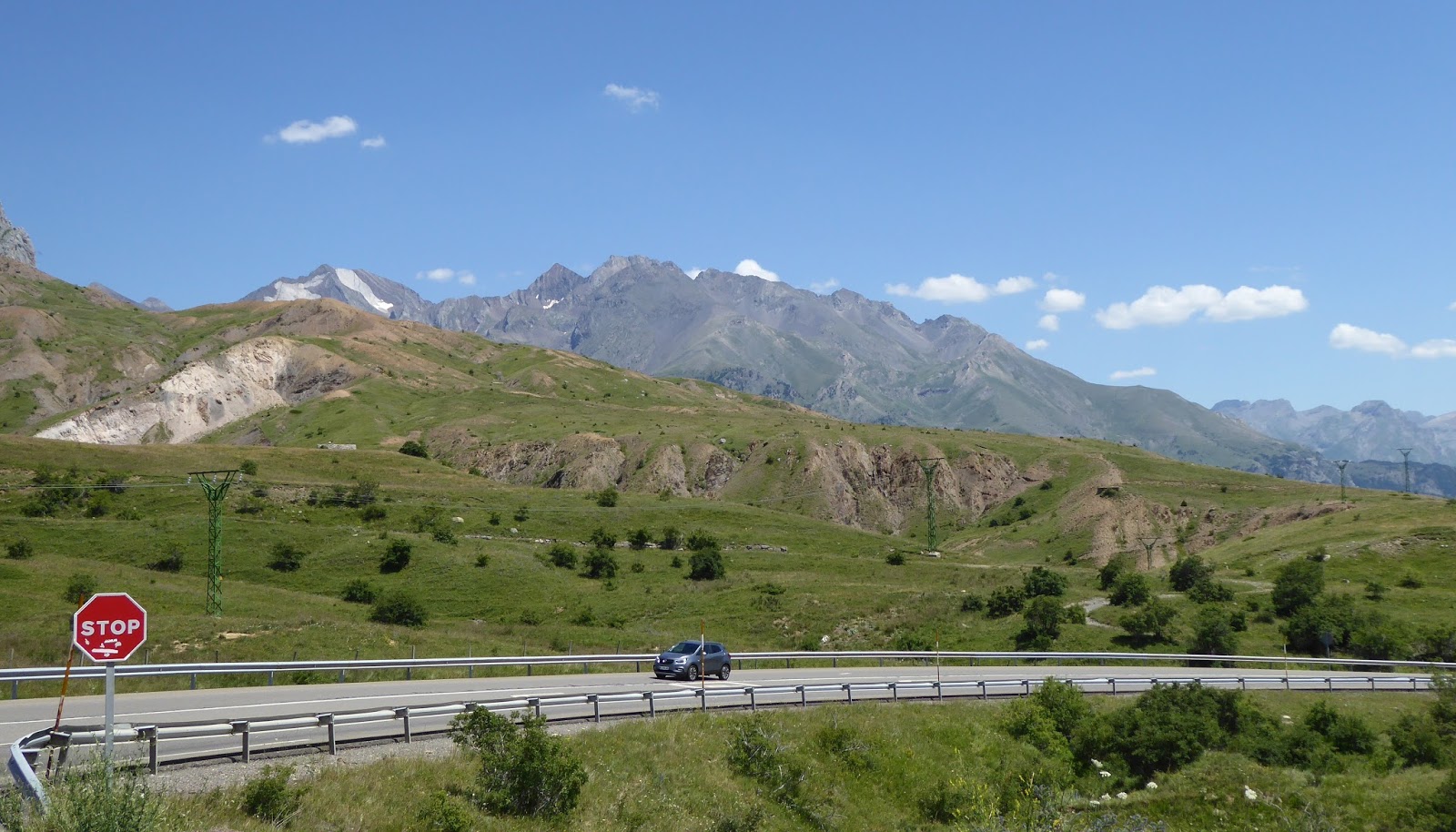
Over to the east we spotted what we thought at first was a couple of big snow patches, though given the hot weather and that we were on the southern side of the mountains, it seemed unusual. A pair of binoculars convinced us that what we could see was (mainly) bands of much paler rock, though there was a little patch of snow at the base of one.
Is that snow on the far peak on the left?
The land in the foreground is the run out from an old landslide.

The binocular view - striking contrasts in rock colour, with just a tiny patch of snow, bottom right
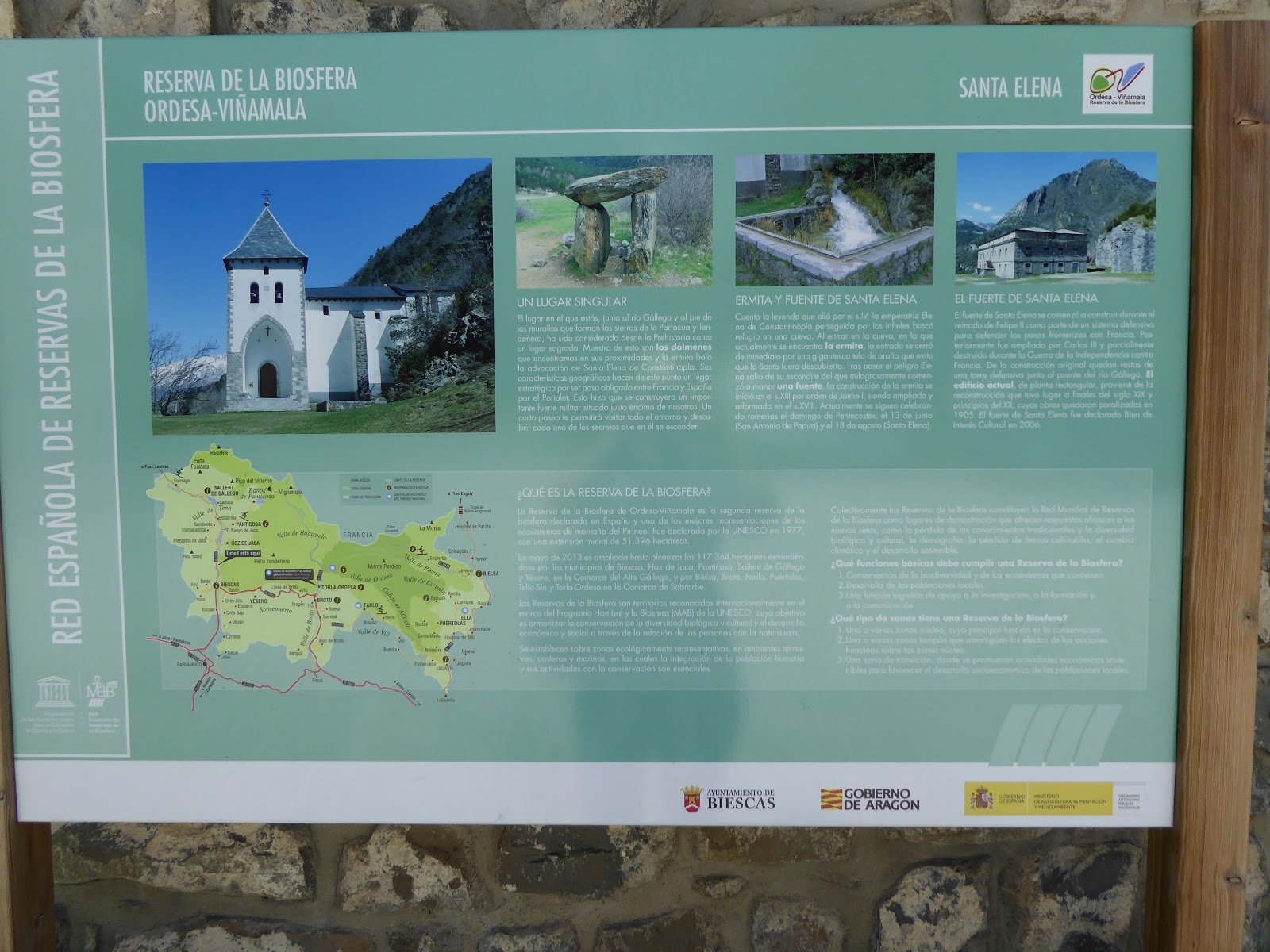
 Further on down the Tena Valley we came across a signpost to Santa Elena hermitage and dolmen but, in common with many signposts here there was absolutely no indication of distance... 5 minutes? ... 2 hours? ... so after walking quite a way when we got to a point where the track turned and went steeply downhill we gave up! It was a warm afternoon and we had a campsite to find!
Information board by the track to Santa Elena - as well as the prehistoric dolmen,
there is a hermitage on the site of a cave where Empress Elena of Constantinople took refuge in the 4th century,
and a fortress built by Philip II to defend the frontier against France.


 We stopped overnight just short of Sabinanigo with a long drive in prospect the next day after our day off in the hills!


Friday, 14 July 2017

Two old bats head for the Pyrenees

Front of the queue doesn't necessarily mean you get on first, but it was awfully handy for the loos! Caught the Mont St Michel and had a beautifully calm crossing from Portsmouth to Caen (Ouistreham) and spent the night on a campsite at Ranville listening to the fireworks on the eve of Bastille Day.
The next morning we were pleased and surprised to find that our route towards Caen took us over Pegasus Bridge and past the Pegasus Cafe!
Didn't take too long to work out that the best place to get a coffee on the move in France is the bakers - the buns are pretty tempting too! We ended up at Saintes (Charente-Maritime) "half way down" on that first evening and after something to eat headed into the town to take a look at it.

The path from the campsite went along the bank of the Charente river, with pleasant views towards the town's "historic centre" and cathedral.


Can't resist a bit of architecture - especially this lovely golden Cretaceous limestone: the Santonian epoch is named after Saintes apparently.
The local limestone

This gargoyle looks as though he needs a dose of castor oil!
After dropping off to sleep to the accompaniment of fireworks again, the next day got us to Laruns on the French side of the Pyrenees, south of Pau.
First decision was whether to go east-about or west-about round Bordeaux - the satnav showed delays both ways and had a hard time making its mind up which route would be quicker! We ended up going west about and, taking an additional diversion to avoid a jammed up bit of motorway, conveniently, found a boulangerie where we could enjoy an after breakfast coffee.
A pause for mid-morning coffee and a bun (need the caffeine!) by a fishing lake also resulted in a bottle of a local aperitif "Pineau" which we kept until we got to La Paz and had a chance to share it with Faboli. I'd not come across it before - it comes in red and white versions - we bought the white - and is served cold. We ended up putting ice with it. Unfortunately left the other half of the bottle behind but hopefully it is tucked away to drink next time!

What a lovely place to go fishing!!!
 The small, informal campsite a couple of km north of Laruns was rather basic (footprint loos!) but half the price of the fancier campsites
The view from the van the next morning shows just how tucked into this steepsided, narrow valley it is!
The evening's tipple was a lovely Oc rose just the tiniest bit petillante. Yummy.
And so, as Pepys would say, to bed. We are planning to spend the next day exploring the local area before heading down through Spain.

Sunday, 2 July 2017

Geology in Chedworth railway cutting with Paul Olver

An OUGS (Severnside) day trip to look at Jurassic limestone in the Cotswolds

The trip was in two sections, the southern exposure of Middle Jurassic Great Oolite in Stony Furlong quarry near Denfurlong Farm Shop and the northern exposure of older (still Middle Jurassic) Inferior Oolite near Chedworth Roman Villa. 
An early start (for a Sunday morning at least!) from Hereford got us to the Farm Shop where we parked while spending the morning looking at Stony furlong quarry, by the southern end of the cutting which is just a short walk away across their campsite. The campsite is on a filled in quarry area from which stone was provided for Chedworth airfield in the mid-20th century
Only right that, since we were using the Farm Shop parking, we should patronise them before starting off. Sausage breakfast baps recommended!
Railway cutting I thought.... level... won't need a walking pole. But I'd forgotten about getting down into it! And then down into the quarry on the far side! Sliding works as well now as it always did though, even if it is a bit hard on the trousers.
Once down in Stony Furlong quarry we could have a look at the exposed face: there is quite a lot of vegetation, and the lower part covered in fallen debris too. A fallen block from the upper section was useful as otherwise that wouldn't have been get-at-able.
Stony Furlong Quarry, Chedworth, with a fallen block from the upper section on the left hand side (south) The quarry face is very stable nowadays. We couldn't get very close (perhaps better in winter when plants have died back!
Paul pointed out the stratigraphy to us and, for a change, there was plenty of time to sketch the exposure!

Not sure how many marks it would have got in a summer school assessment!

More or less the bit I sketched


.


The quarry exposes the White Limestone Formation at the base of the Great Oolite Group. The upper part is the Ardley Member was deposited in fully marine conditions and apparently exhibits more biodiversity (lots of brachiopods plus some echinoids, ammonites and crustaceans). The lower Shipton Member was deposited in a more restricted environment (estuarine/lagoonal?) and has less diverse fauna (bivalves and gastropods). 
During the Middle Jurassic this area lay around 30 degrees north, in an arm of the closing Tethys Ocean. Global climate was warm, with no glaciation. The Atlantic was opening, and there was also plate tectonic movement in the Indian ocean. Tectonic plate break up created more ocean ridge length and consequently higher sea levels, flooding extensive continental shelf areas. Generally it was a time of rising sea level, with occasional still-stands and only very brief periods of falling sea level. What's now the Cotswolds was an area of shallow water tropical sea with shifting ooid shoals on a stable shelf. This has resulted in a complex, interfingering stratigraphy!
Lots of fossil hunting and hammering went on but I didn't see anyone find anything particularly impressive!
At midday we broke for lunch, agreeing to meet at Chedworth Roman Villa to begin the afternoon part of the excursion. The overflow car park is beautifully shady and, not wanting lunch after that sausage bap, Jan and I took Libby to find the others at the National Trust cafe which is conveniently outside the actual villa area (no need to pay to go in, though must go back sometime to take a proper look at the villa itself!)
Paul had suggested restarting at 2pm but as we were all ready to go (apart from a few stragglers who had temporarily converted into archaeologists and who had to be rounded up), we headed up the hill behind the cafe, via some convenient (but steep!) steps to the disused railway track. 
A mile of track runs from a blocked off tunnel at the southern end, to a road (blocked off) at the northern end, and allows access to rocks of the Inferior Oolite Group.
During the Middle Jurassic blocks were being actively uplifted which resulted in gentle warping and folding of all but the uppermost Inferior Oolite strata. 
Heading south to the tunnel we looked first at the Clypeus Grit, named after an irregular echinoid (rather like a sand dollar). Grit in this instance isn't a sandstone but a rubbly, fossiliferous limestone and, once again, the fossil hunters spent some time happily hammering away in the hopes of finds!
From here we retraced our steps to a spring and waterfall which is depositing tufa (calcium carbonate from the limestone through which the water passes) on the moss and liverwort covered surface. This is similar to the "petrifying wells" found in Yorkshire and Derbyshire.
The tufa waterfall

And a closer view of the calcium carbonate coated mosses and liverworts of the Tufa Waterfall
Heading back northward, we came to exposures of the Upper Trigonia Grit, stratigraphically below the Clypeus Grit, and which sits unconformably here on the white, oolitic, Notgrove Freestone.
The unconformity is hard to see as there is little change in attitude between the strata above and below, but it is marked out but a layer which has been eroded back more than the other strata.
The Notgrove Member (previously Notgrove Freestone) is the youngest pre-unconformity rock and sits in the centre of a syncline here.
The unconformity below the Upper Trigonia Grit is marked by the layer midway up that has been eroded back

A cleaner section enabled a better view of the rocks!

We found Trigonia fossils (left) and also an internal mould of Trigonia

Another view of the interior mould (and if you want to know how I know what it is, it comes of drawing one for my A level practical notebook some 50+ years ago)
Once drawn, never forgotten! Just a shame we weren't encouraged to include a scale and labels :(
Wouldn't have done too well if I'd been marking it for an assignment!
(We used to call bivalves "lamellibranchs" then by the way)
A normal fault downthrows the Clypeus Grit against the oldest rocks seen. Just before the high embankment at the northern end, we came to a section through the oldest rocks in the section, the Birdlip Limestone (pale grey), Gryphite Grit and Lower Trigonia Grit (shelly, orangey-brown). These have been upfaulted into this position as a small horst. 
The oldest strata in the section

The elongate Jurassic bivalve, Gervillella. A "boring piddock"
 There was a discussion about the "boring piddocks" which I missed!
A sample of the hardground from below the unconformity.
Vertical lines are burrows down into the rock from the upper surface.
Proof of an otherwise hard-to-find unconformity were samples of a hardground with a bored upper surface.
The walk along the railway line had been pleasantly level through shady woodland, though a bit midgy. We headed back to the steps, and down to the cafe where people variously enjoyed coffee, tea, cake, and icecreams, and Norman, our Branch Organiser, thanked Paul with a bottle of wine for guiding us through the section.
It was interesting to contrast this section with the Carboniferous ramp we saw at Three Cliffs Bay a few weeks ago. There there was a continuous stretch of almost vertical beds so we could travel back in time simply by walking down the beach. There were distinct rises and falls in sea level attributed to glacials and interglacials during the Carboniferous and non-depositional surfaces were karstified by subaerial exposure.  At Chedworth the strata were pretty much horizontal and non-depositional surfaces were subaqueous hardgrounds. The rising sea level was the result of tectono-eustasy rather than glacioeustasy. Nice to see the two very different carbonate sections in a short space of time! Thanks to Jan for organising yet another good trip.